

Understanding Skin Concerns Before Defining Treatment Objectives
Introduction
Skin booster clinical indications provide a practical starting point for understanding which skin concerns should be considered before defining a treatment strategy. Dehydration, fine lines, loss of elasticity, dullness, and signs of photoaging may appear straightforward. However, these concerns often overlap. As a result, similar-looking skin conditions may lead to different treatment objectives.
In our previous article, Skin Booster Treatment Objectives, we explored treatment goals such as hydration, regeneration, collagen support, and overall skin quality improvement. In this guide, we take one step back and focus on the skin concerns that practitioners may consider before defining those objectives.
We will explore six common skin concerns and explain how understanding them can support more informed treatment planning.
Note: The clinical indications discussed in this article refer to general skin concerns considered in aesthetic practice. They should not be interpreted as approved medical indications for any specific product.
What Are Skin Booster Clinical Indications?
In aesthetic practice, a clinical indication describes the skin condition or concern being considered before a treatment strategy is defined.
For example, a patient may present with dehydrated skin. However, dehydration alone does not determine which formulation or product should be selected. Fine lines, reduced elasticity, uneven skin quality, or broader signs of aging may also be present.
Therefore, skin booster clinical indications can be viewed as the starting point of treatment planning rather than the final answer.
A simple decision process is:
Skin Concern ▶ Treatment Objective ▶ Formulation Technology ▶ Product Consideration
This approach separates what practitioners observe from what they ultimately aim to achieve.
Clinical Indications vs
Skin Booster Treatment Objectives
Clinical indications and treatment objectives are closely connected, but they answer different questions.
| Clinical Indication | Treatment Objective | |
| Key Question | What skin concern are we addressing? | What do we want to achieve? |
| Focus | Current skin condition | Desired treatment direction |
| Examples | Dehydration, fine lines, dullness | Hydration, regeneration, collagen support |
| Role | Starting point for assessment | Guides treatment planning |
For example, dehydrated skin may lead to a hydration-focused objective. However, if dehydration appears together with loss of elasticity and fine lines, a broader skin quality strategy may be considered.
Therefore, one visible concern does not always mean one treatment objective.
Why Skin Booster Clinical Indications Matter
Skin boosters include a range of injectable materials and treatment approaches. A current peer-reviewed overview discusses skin boosters in relation to age-related changes such as dullness, dehydration, and loss of elasticity, while also reviewing different materials, mechanisms, and clinical uses. Therefore, selecting a solution based only on a familiar ingredient or product name may overlook the broader skin condition.
Instead, treatment planning can begin by identifying the primary concern. Practitioners can then consider whether other skin concerns are present at the same time.
This is particularly relevant for aging skin, where several visible changes may occur together rather than as separate concerns. Understanding these overlapping conditions provides a clearer foundation for defining treatment objectives before evaluating formulation options.
6 Common Skin Booster Clinical Indications
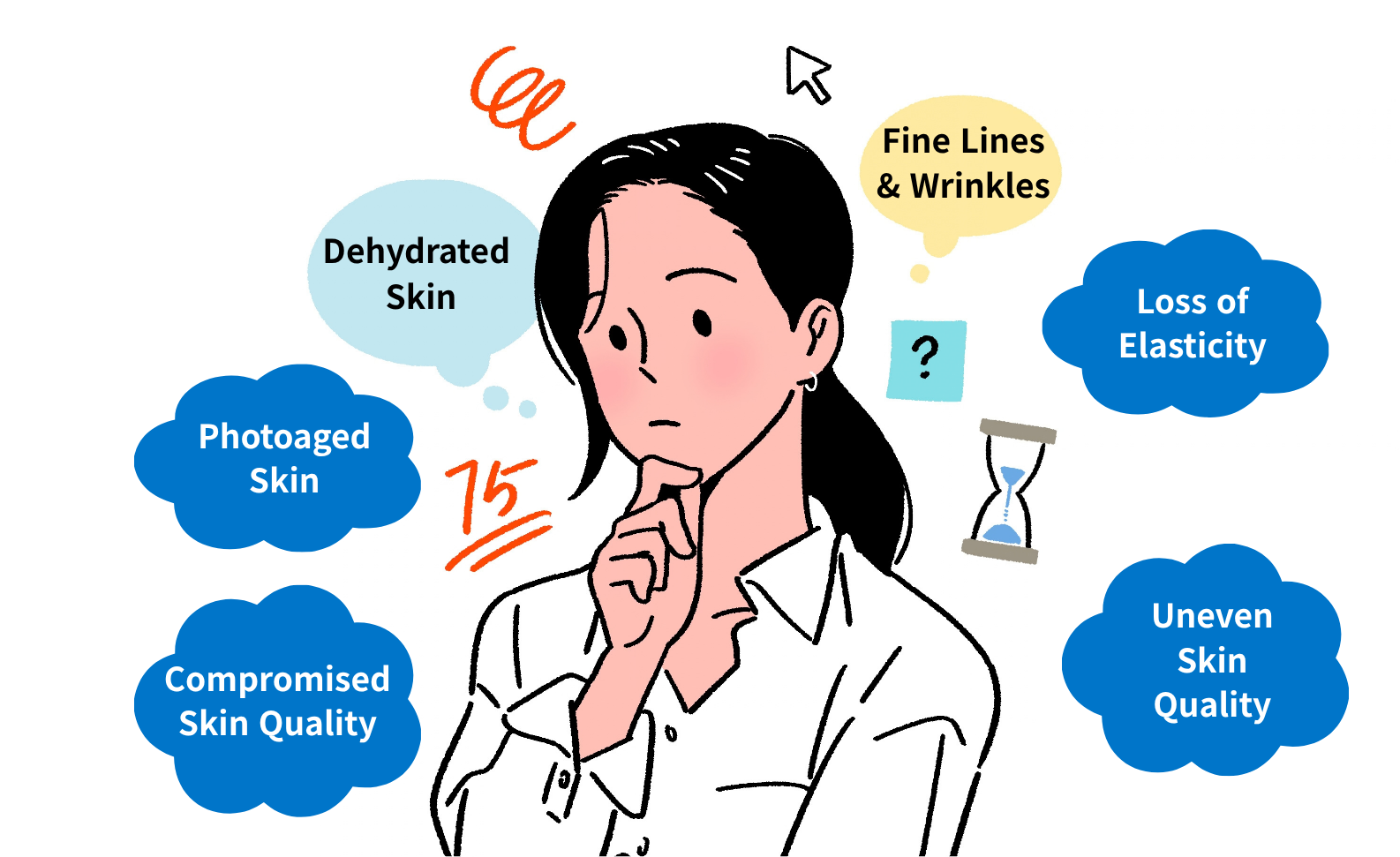
Although individual skin conditions vary, several common concerns may influence skin booster treatment planning. The following six skin booster clinical indications show how visible skin concerns can provide a starting point for the next stage of treatment planning.
1. Dehydrated Skin
– What It Means
Dehydrated skin lacks sufficient moisture and may appear dry, rough, or less supple. Fine dehydration lines may also become more noticeable.
– What to Consider
However, dehydration does not always appear alone. It may occur alongside reduced elasticity, fine lines, or other signs of aging.
Therefore, it is useful to consider whether hydration is the primary concern or one part of a broader change in skin quality.
– Treatment Direction
Treatment planning may begin with hydration and skin quality support, while other concerns are considered separately.
2. Fine Lines & Wrinkles
– What It Means
Fine lines and wrinkles are common visible concerns in aesthetic practice. However, not all lines appear under the same skin conditions.
– What to Consider
For example, fine lines may become more noticeable when skin is dehydrated. In other cases, they may appear alongside reduced elasticity or broader age-related changes.
Therefore, visible lines alone may not provide enough information to define the treatment strategy.
– Treatment Direction
Depending on the overall skin condition, treatment objectives may include hydration, skin quality improvement, regeneration, or structural support.
3. Loss of Elasticity / Skin Laxity
– What It Means
When skin elasticity decreases, the skin may appear less firm and show visible signs of laxity.
– What to Consider
Loss of elasticity may occur alone or together with fine lines, dehydration, and other signs of aging. Therefore, the broader skin condition should also be considered.
– Treatment Direction
Treatment planning may focus on elasticity, skin quality, and collagen support, depending on the individual’s broader skin needs.
4. Dull or Uneven Skin Quality
– What It Means
Not every patient presents with one dominant concern such as wrinkles or laxity. Instead, some may notice that their skin looks dull, tired, or uneven in overall quality.
– What to Consider
These changes may occur alongside dehydration, environmental exposure, or broader age-related changes.
As a result, treatment planning may need to consider overall skin quality rather than focusing on one visible feature.
– Treatment Direction
Possible objectives may include revitalization, regeneration, hydration, and overall skin quality support.
5. Aging / Photoaged Skin
– What It Means
Aging and photoaged skin demonstrate why clinical indications and treatment objectives should be considered separately.
Intrinsic aging and external factors can both contribute to changes in skin appearance. In particular, chronic sun exposure is a major external contributor to photoaging, which commonly presents with wrinkles and pigmentary changes. At the same time, other age-related concerns may also be present.
– What to Consider
Because several concerns can overlap, focusing on only one visible sign may provide an incomplete picture.
Instead, practitioners may first identify which concerns are most prominent and then determine which treatment objectives should be prioritized.
– Treatment Direction
Aging or photoaged skin may call for a multi-dimensional approach, depending on the combination of visible concerns and the individual’s overall skin condition.
6. Stressed or Compromised Skin Quality
– What It Means
Repeated environmental exposure, dryness, and other external factors may affect the appearance and overall quality of the skin. As a result, the skin may appear less resilient, dull, or uneven.
Here, the focus is not on treating wounds or medical skin conditions. Instead, it is on understanding the overall condition of aesthetically stressed skin.
– What to Consider
Practitioners may consider whether the visible changes are mainly associated with dehydration, environmental stress, broader aging concerns, or several factors together.
Therefore, the treatment direction may vary even when the skin initially appears similarly stressed.
– Treatment Direction
Treatment planning may consider skin quality, recovery, and regenerative support according to the overall skin condition.
Why One Skin Concern
May Have Multiple Objectives
One of the key principles behind skin booster clinical indications is that similar-looking concerns do not always lead to the same treatment objective.
Consider two patients with visible fine lines.
- For one patient, dehydration may be the dominant concern. Therefore, hydration may become the primary objective.
- For another patient, similar fine lines may appear together with reduced elasticity, dullness, and broader signs of aging. In this case, treatment planning may involve several objectives rather than hydration alone.
Aging skin provides another clear example. Several visible changes can occur together, so a single concern may be only one part of the overall skin condition.
Therefore, clinical indications help practitioners identify and interpret the concern before moving toward formulation or product consideration.
From Skin Booster Clinical Indications
To Treatment Planning
Once the main skin concerns have been identified, practitioners can translate those observations into possible treatment objectives.
| Clinical Indication | Possible Treatment Direction |
| Dehydrated Skin | Hydration & skin quality support |
| Fine Lines & Wrinkles | Hydration, regeneration or structural support |
| Loss of Elasticity / Skin Laxity | Elasticity & collagen support |
| Dull or Uneven Skin Quality | Revitalization & regeneration |
| Aging / Photoaged Skin | Multi-dimensional skin quality approach |
| Stressed or Compromised Skin Quality | Skin quality, recovery & regenerative support |
Once the treatment objective is defined, the next step is to evaluate which formulation technology may support that goal.
This creates a simple framework:
Assess the Concern ▶ Define the Objective ▶ Evaluate the Formulation ▶ Consider the Product
Rather than beginning with a product, this approach starts with the skin condition and moves through each stage of treatment planning.
Connecting Clinical Needs
With Formulation Technologies
Different formulation technologies support different aesthetic treatment strategies. Therefore, formulation consideration can follow the treatment objective rather than the product name alone.
▷ Hydration & Skin Quality Support
Hybrid Dual HA technologies may be considered when hydration and overall skin quality are key priorities. INHILO+ is one example of this formulation approach within the BS PHARM KOREA portfolio.
▷ Regeneration & Revitalization
PDRN-based approaches may be evaluated when treatment planning focuses on regenerative skin quality. NA:DRN, formulated with NAD⁺ and PDRN, represents this approach within our portfoli
▷ Cellular Communication & Regenerative Support
Exosome-based formulations represent another approach within regenerative aesthetics. EXOGEN is an example of this formulation category within the BS PHARM KOREA portfolio.
▷ Collagen Support
PLLA-based formulations may be considered when collagen stimulation forms part of the treatment objective. The BS PHARM KOREA portfolio includes PLLA-based solutions developed around this treatment direction.
The purpose is not to match one product directly to one visible concern. Instead, clinical indications, treatment objectives, and formulation technologies can be considered together before a product is evaluated.
Conclusion
Understanding skin booster clinical indications provides a clearer starting point for aesthetic treatment planning.
Visible concerns such as dehydration, fine lines, loss of elasticity, dullness, photoaging, or stressed skin quality can provide useful information. However, they should not automatically determine which formulation or product is considered.
Instead, a structured approach begins by identifying the skin concern, defining the treatment objective, and then evaluating the formulation technology that may support that goal.
Start with the skin—not the product.
By understanding how clinical indications, treatment objectives, and formulation technologies connect, aesthetic professionals can approach skin booster selection through a more informed and structured decision-making process.
Frequently Asked Questions
What are the most common skin booster clinical indications?
Common concerns may include dehydrated skin, fine lines and wrinkles, loss of elasticity, dull or uneven skin quality, photoaging, and stressed skin quality. Individual skin conditions can vary, and several concerns may occur together.
What is the difference between a clinical indication and a treatment objective?
A clinical indication describes the skin concern being considered, while a treatment objective describes what the treatment aims to achieve, such as hydration, regeneration, or collagen support.
Does one skin concern require one skin booster formulation?
Not necessarily. Similar-looking concerns may have different characteristics, while several concerns may occur together. Therefore, formulation consideration should follow the overall treatment objective.
How do clinical indications influence skin booster selection?
A practical approach is to first identify the skin concern, then define the treatment objective, and finally evaluate formulation technologies that may support that objective.
Explore the Skin Booster Knowledge Series
Continue exploring the factors behind professional skin booster selection.
- Skin Booster Selection Guide | 5 Factors for Aesthetic Clinics
– Explore five key factors that can help clinics evaluate professional skin booster solutions. - Choosing the Right Skin Booster Starts with Formulation
– Compare Hybrid Dual HA, PDRN, PLLA, Exosome, and ECM formulation technologies and their different approaches. - Skin Booster Treatment Objectives
– Learn how hydration, regeneration, collagen support, and other treatment objectives can guide formulation consideration.
Looking for the Right Solution
For Your Clinical Needs?
Different skin concerns may require different treatment objectives and formulation technologies.
If you are looking for professional aesthetic solutions that align with your clinical or market needs, contact the BS PHARM KOREA team to explore our skin booster and regenerative aesthetics portfolio.


